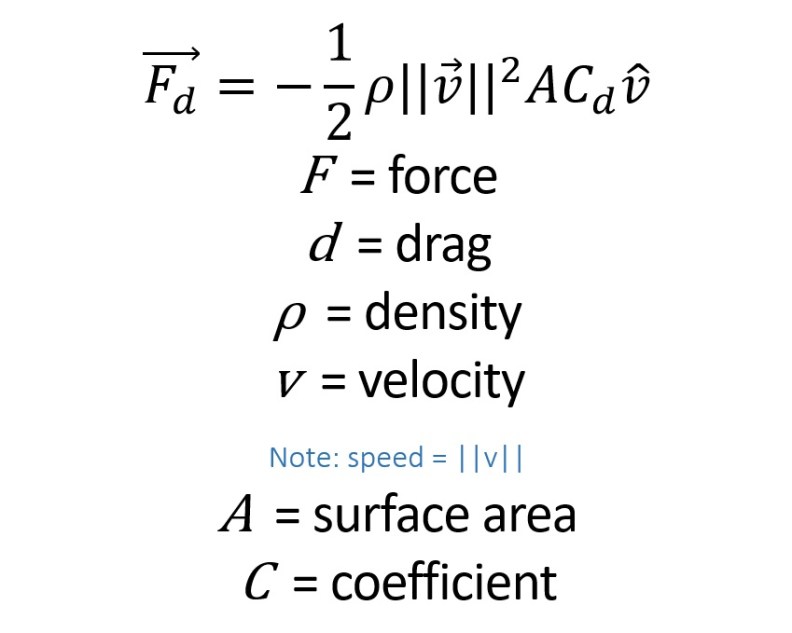
Today Simon was watching Daniel Shiffman’s tutorials to learn about drag force and how to apply it when building a spring simulation in p5.js. Simon wrote the formula for drag force in Microfost Word and looked up all the variables:
While building a spring in p5.js, Simon talks about the 3 laws of Isaac Newton:
The project is based upon Daniel Shiffman’s book The Nature of Code, specifically Chapter 3 (Oscillation). Simon spent the rest of the evening studying “simple harmonic motion”, periods and amplitudes. Here is an excerpt from Daniel Shiffman’s book:

y = sine(x)
You’ll notice that the output of the sine function is a smooth curve alternating between –1 and 1. This type of a behavior is known as oscillation, a periodic movement between two points. Plucking a guitar string, swinging a pendulum, bouncing on a pogo stick—these are all examples of oscillating motion.
This is what is known as simple harmonic motion (or, to be fancier, “the periodic sinusoidal oscillation of an object”). It’s going to be a simple program to write, but before we get into the code, let’s familiarize ourselves with some of the terminology of oscillation (and waves).
Simple harmonic motion can be expressed as any location (in our case, the x location) as a function of time, with the following two elements:
-
Amplitude: The distance from the center of motion to either extreme
-
Period: The amount of time it takes for one complete cycle of motion
 Geeks out of the box